
Silver (XAG/USD) traded lower on Tuesday, hovering around $76.30 during Asian trading hours, after posting a 2.36% gain the previous day. The precious metal saw its safe-haven demand ease following the postponement of a potential military strike on Iran, reducing immediate geopolitical risk in global markets. Taurus Partners’ experts carefully dissect this topic in the following article.
Geopolitical Developments and Silver Demand
Silver prices are highly sensitive to risk sentiment, particularly in response to Middle East tensions. Elevated fears of conflict had previously supported a surge in XAG/USD, but the delay in the planned attack temporarily eased market anxiety. Traders reduced long positions in silver, reflecting diminished risk aversion, while equity markets responded positively.
The delay allows additional time for diplomatic negotiations in the region. While military action remains a possibility if talks fail, no definitive timeline has been announced. This uncertainty contributes to volatility in XAG/USD, which historically reacts to both geopolitical risk and macroeconomic indicators.
Inflationary Pressures and Energy Prices
Persistent inflation continues to weigh on silver, driven by elevated energy prices linked to ongoing conflicts in the Middle East. Crude oil futures remain above $95 per barrel, while natural gas benchmarks in Europe have stabilized near $36/MMBtu, maintaining upward pressure on consumer prices.
Higher energy costs contribute to core inflation, which increases the probability of prolonged interest rate hikes by major central banks. Silver, as a non-yielding asset, suffers when real yields rise, as investors shift capital toward yield-bearing instruments.
Monetary Policy Implications
US monetary policy expectations are exerting additional pressure on XAG/USD. The latest CPI data indicated headline inflation at 3.9% year-on-year, above the central bank’s target range. This has led market participants to discount rate cuts for the remainder of the year and reassess the likelihood of additional hikes.
The 10-year US Treasury yield jumped to 4.659%, its highest level since February 2025, before settling near 4.609%. The move reflects investor concern that sustained energy price inflation will feed into broader consumer price inflation, prompting tighter monetary policy.
Upcoming releases, including FOMC minutes and flash PMI data, are expected to provide insight into economic momentum and potential policy adjustments. Any signals that the central bank may moderate or accelerate rate changes could significantly impact silver prices, given their sensitivity to real interest rate movements.
Technical Market Dynamics
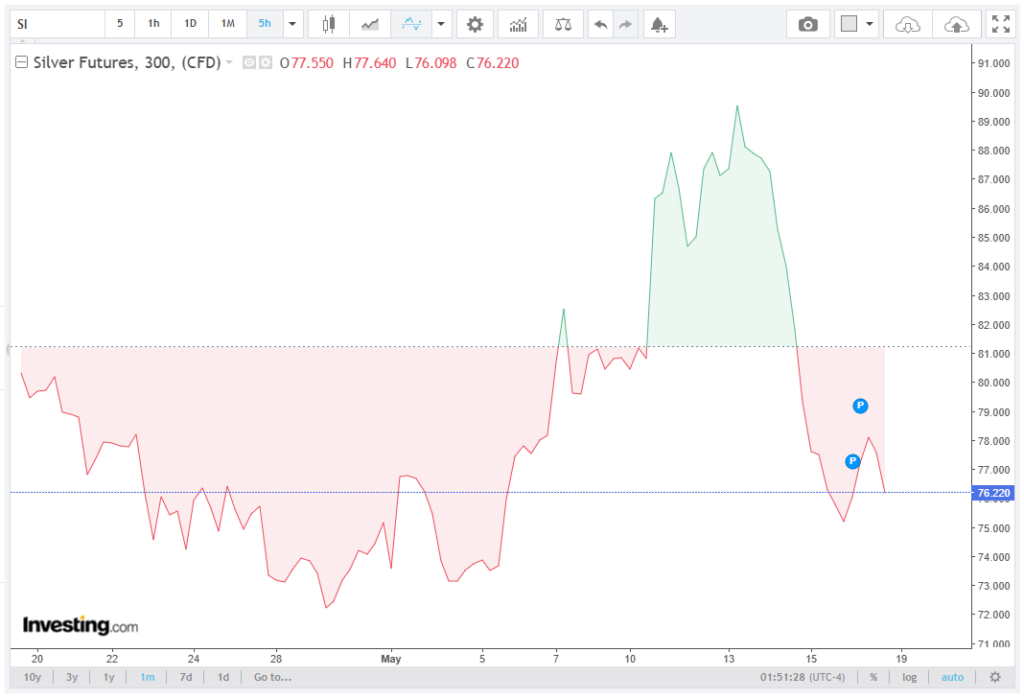
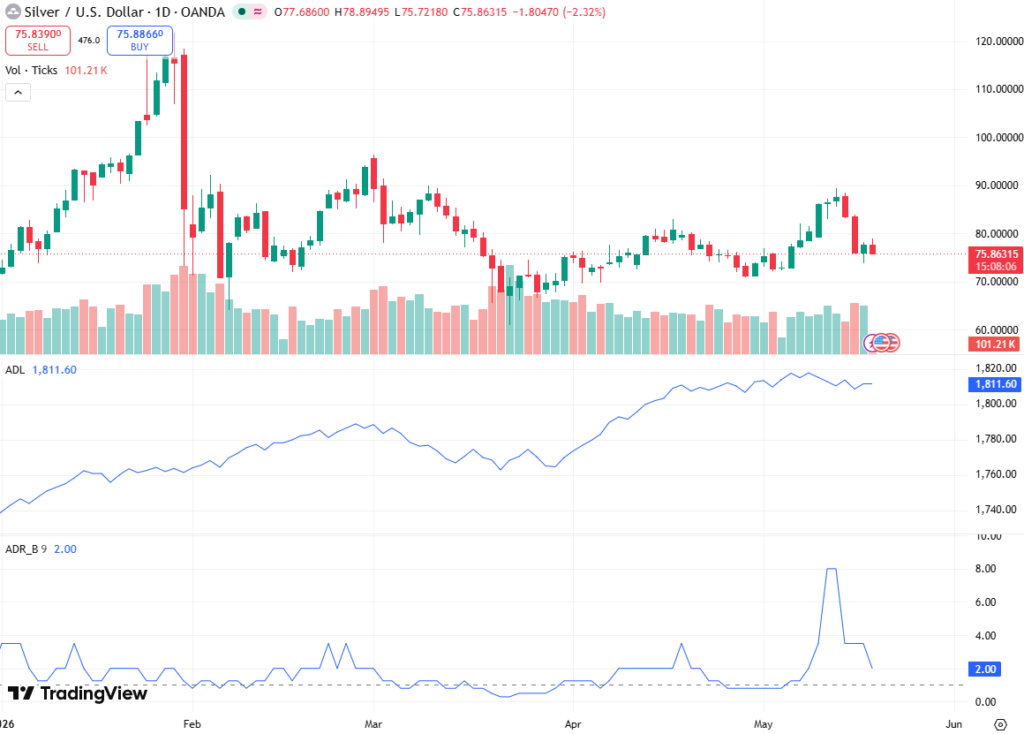
Silver remains in a consolidation range, with immediate resistance at $76.50-$77.00 and support near $75.80-$76.00. Recent price swings reflect a retracement from prior gains, as short-term momentum indicators signal subdued bullish pressure.
Relative Strength Index (RSI) on the 4-hour chart is near 52, suggesting a neutral momentum environment. The 20-day moving average remains below the 50-day moving average, indicating that the short-term trend is weaker than the intermediate trend.
Open interest in COMEX silver futures has declined slightly by 0.8%, consistent with reduced speculative demand. Meanwhile, volume metrics remain moderate, implying limited conviction among traders until further geopolitical or economic signals emerge.
Real Yields and Inflation Hedge Considerations
Silver’s price trajectory is closely linked to real yields, calculated as the nominal yield on 10-year Treasuries minus expected inflation. With yields at 4.609% and market-based inflation expectations near 2.6%, the real yield is roughly 2.0%, which remains high for supporting non-yielding assets.
Historically, silver tends to underperform when real yields exceed 1.5%-2.0%, as opportunity costs increase. Conversely, any sudden spike in geopolitical risk or energy-driven inflation could push XAG/USD above key resistance levels, as traders seek a hedge against currency and price pressures.
Risk Assessment and Market Outlook
The short-term outlook for silver remains subdued, shaped by three major factors. Geopolitical tension plays a role, as delayed military action reduces immediate safe-haven buying, though any escalation could quickly reverse this trend.
Monetary policy also impacts silver, with elevated inflation and real yields suggesting limited upside for non-yielding assets until the rate trajectory becomes clear. Finally, energy costs, including crude oil above $95 per barrel and high natural gas prices, sustain inflationary expectations, which indirectly affect silver prices.
Traders should monitor Treasury yields, inflation data, COMEX open interest, and flash PMI readings to anticipate potential XAG/USD breakouts. Technical levels remain critical, with support at $75.80 acting as a near-term floor and resistance at $76.50-$77.00 serving as a ceiling unless macroeconomic shocks intervene.
Conclusion
Silver (XAG/USD) is currently navigating a complex environment characterized by geopolitical uncertainty, inflationary pressure, and monetary policy considerations. The delay of the military strike on Iran temporarily reduced risk aversion, lowering safe-haven demand for silver.
For now, XAG/USD remains subdued, balancing between macroeconomic caution and temporary geopolitical relief, with potential volatility linked to energy markets and monetary policy signals.