
The British Pound (GBP) continues to underperform against the Euro (EUR) as the EUR/GBP cross regains traction after a sharp reversal from the 0.8730 level, the highest since April 7. The brokers at Taurus Partners examine this topic in detail in their recent article.
Market participants are closely analyzing the latest UK labor market data alongside ongoing political uncertainty and the European Central Bank’s (ECB) monetary stance to assess potential directional bias for sterling.
EUR/GBP Technical Snapshot
On Tuesday, the EUR/GBP pair stabilized near 0.8680, slightly above the intraday low of 0.8675, following the 0.8730 retracement experienced in the previous session. The relative strength index (RSI) currently hovers around 56, suggesting a mild bullish bias, but momentum remains limited. The 50-hour simple moving average (SMA) near 0.8685 is acting as immediate support, while resistance remains capped at 0.8730–0.8740, representing the prior swing high.
Intraday volatility has been moderate, with an average true range (ATR) of 0.0042, indicating that traders are taking a cautious approach amid mixed fundamentals. The current EUR/GBP bid-offer spread is 0.0001, reflecting relatively tight liquidity conditions in the European session.
UK Employment Data: Mixed Signals
The Office for National Statistics (ONS) reported that the ILO unemployment rate rose unexpectedly to 5.0% in the three months to March, compared to 4.9% in the prior period. This represents a 0.1 percentage point increase, signaling mild weakness in the labor market.
The Claimant Count Change for April came in at 26.5K, below market expectations of 27.3K, providing a modest offset to downside pressure on the GBP. The previous month’s Claimant Count Change was revised downward sharply from 26.8K to 4.9K, further limiting potential GBP depreciation.
Average weekly earnings growth, excluding bonuses, remained unchanged at 4.2% year-on-year, consistent with prior readings. Including bonuses, earnings growth edged up marginally to 5.0% YoY, slightly below forecasts of 5.1%. These figures suggest that wage pressures remain moderate, providing little impetus for GBP strength in the near term.
ECB Monetary Policy Support for the Euro
The Euro continues to benefit from a hawkish monetary policy stance. Market-implied ECB policy expectations indicate a 50% probability of a 25 basis point rate increase in the upcoming meeting, while the 5-year, 5-year forward inflation swap remains anchored at 2.0%, supporting the view of a controlled inflation environment.
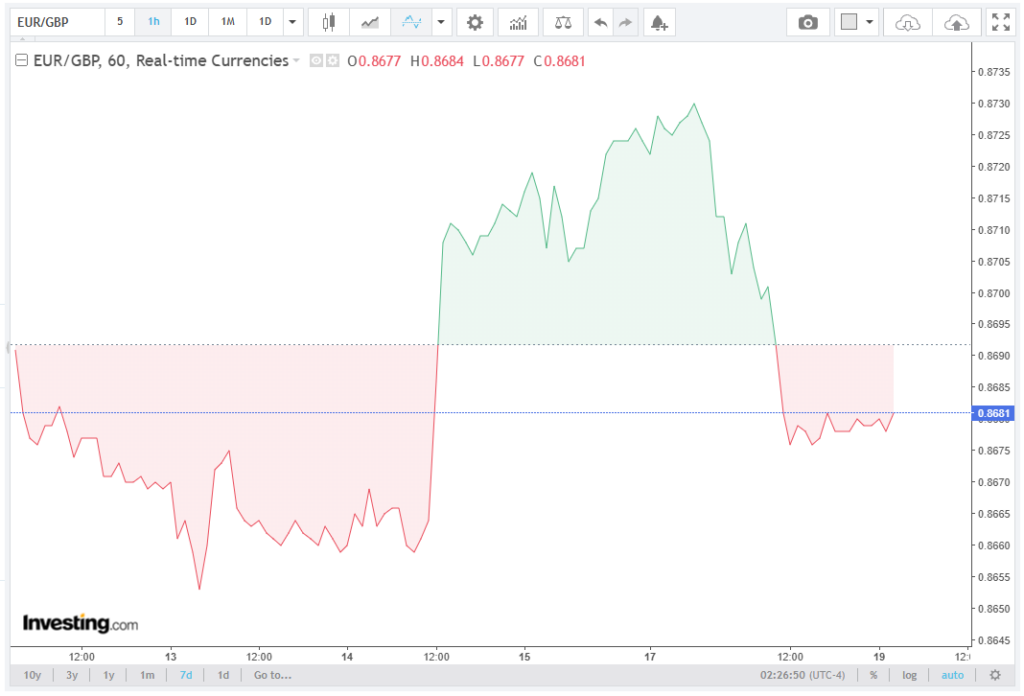
The differential between the 1-year forward EUR interest rate and the 1-year forward GBP interest rate stands at +0.35 percentage points, favoring EUR carry trades. This policy divergence underpins the EUR/GBP uptrend, as traders position for incremental interest-rate advantages in the Eurozone.
Technical and Market Implications
From a technical perspective, the EUR/GBP cross is currently consolidating above 0.8675, with the 0.8680–0.8700 zone acting as immediate support. The 0.8730–0.8740 area remains the key resistance level. Short-term momentum indicators such as the 14-period MACD suggest mild bullish conditions, but the crossover has not yet confirmed a sustained move higher.
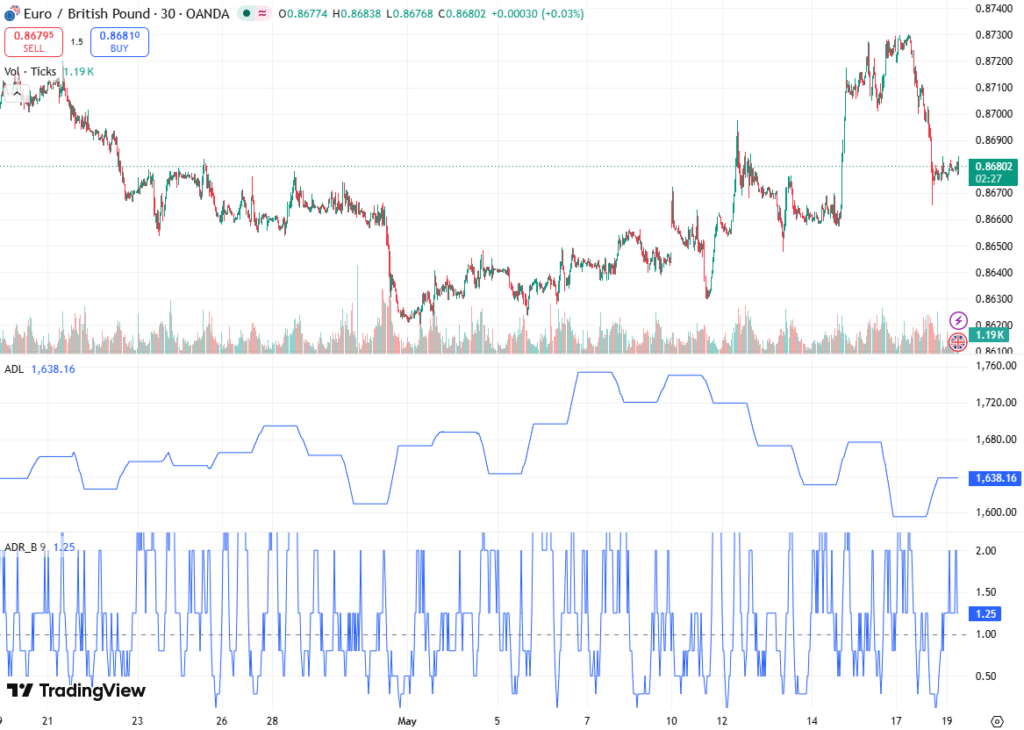
The EUR/GBP 1-hour Bollinger Bands indicate that volatility remains moderate, with the upper band at 0.8715 and the lower band at 0.8660, suggesting potential for a narrow range-bound session unless triggered by new data. Traders may focus on UK labor market updates, upcoming inflation figures, and any further political developments to anticipate breaks above or below the current range.
Market Reaction to Data
The mixed employment data have resulted in limited intraday reaction. While the unexpected rise in unemployment suggests structural weakness, the slightly lower claimant increase and downward revision of prior data provide marginal support to sterling. Market participants have maintained short-term EUR/GBP long positions, as reflected in a net-long open interest increase of 8% over 24 hours.
GBP-denominated assets, including gilts, have shown mild underperformance, with the 10-year UK government bond yield declining by 3 basis points to 3.82%, while the German Bund 10-year yield increased by 2 basis points to 2.46%, further widening the yield differential in favor of the Euro.
Conclusion: GBP Remains Vulnerable
In conclusion, the GBP remains on the defensive against the EUR due to a combination of mixed employment data, political uncertainty, and ECB hawkishness. The EUR/GBP cross has found short-term support near 0.8680, but resistance at 0.8730 will continue to cap upside unless stronger UK economic data emerges.
Traders should monitor weekly UK labor reports, sterling volatility, and monetary policy signals from the ECB to assess the potential for EUR/GBP directional shifts. Given the current macroeconomic and political landscape, the Euro retains relative strength, and any GBP recovery appears likely to be modest and short-lived unless unexpected positive data or political clarity emerges.