

The GBP/USD currency pair traded in a narrow range on Tuesday, reflecting a market gripped by geopolitical uncertainty and central bank anticipation. The pair hovered around 1.3310, recovering modestly from this month’s low of 1.3218, as traders balanced risk sentiment with expectations surrounding upcoming monetary policy decisions. In this article, the brokers at Taurus Partners present a comprehensive analysis of the subject.
A key driver of recent price action has been the escalating Iran conflict and renewed pressure from the US President urging global cooperation to reopen the Strait of Hormuz, a critical artery for global oil and fertilizer shipments. This geopolitical tension has injected volatility into energy markets, indirectly influencing currency flows, particularly those sensitive to risk appetite like the British pound.
Despite heightened tensions, the GBP/USD pair has remained relatively stable, suggesting that investors are adopting a wait-and-see approach ahead of pivotal announcements from the Federal Reserve and the Bank of England (BoE).
Energy Markets and Macro Influence
The energy complex remains a crucial factor shaping the macro landscape. Both Brent crude and West Texas Intermediate (WTI) prices experienced a slight pullback, settling near $100 and $94, respectively. This modest decline came amid diplomatic pressure to restore shipping routes through the Strait of Hormuz.
However, the broader outlook for oil remains bullish, as analysts expect Iran to maintain upward pressure on prices. Elevated energy costs have a direct impact on inflation dynamics, particularly in advanced economies like the United Kingdom and the United States, where fuel, fertilizer, and transportation costs continue to rise.
For currency markets, persistently high oil prices tend to reinforce inflation expectations, complicating the decision-making process for central banks. This creates a delicate balance between controlling price stability and avoiding a slowdown in economic growth.
Federal Reserve Outlook: Rates on Hold but Risks Elevated
Attention now shifts to the upcoming Federal Reserve interest rate decision, which is expected to be a major catalyst for the GBP/USD exchange rate. Market consensus suggests that the Fed will maintain its benchmark interest rate within the 3.50%–3.75% range, where it has remained in recent months.
Despite holding rates steady, the Fed faces mounting challenges. Inflation remains stubbornly high, driven by sustained increases in gasoline prices, travel expenses, and agricultural inputs. These pressures raise concerns that inflation could become more entrenched, especially if energy prices rebound.
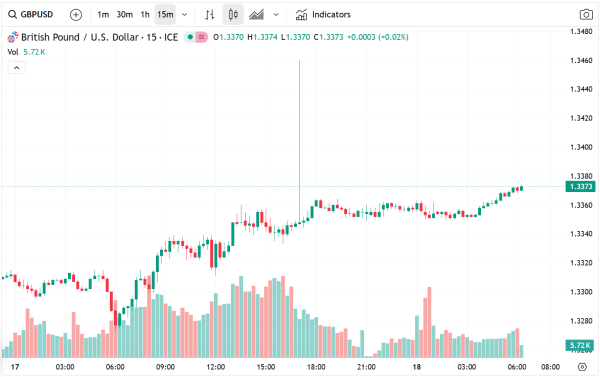
As a result, investors will closely scrutinize the Fed’s forward guidance, particularly any signals regarding future rate hikes or a prolonged period of restrictive monetary policy. A more hawkish stance could strengthen the US dollar, putting downward pressure on GBP/USD.
Bank of England: Hawkish Tone Expected
Parallel to the Fed, the Bank of England (BoE) is also set to announce its interest rate decision, with economists widely expecting no change from the current 3.75% level. However, the tone of the BoE’s communication may prove more influential than the decision itself.
Recent economic data from the UK has shown persistent inflationary pressures, particularly in core consumer prices and wage growth. This has prompted expectations that the BoE will adopt a more hawkish posture, signaling readiness to tighten policy further if inflation does not ease.
A hawkish BoE, combined with a neutral Fed, could provide short-term support for the British pound, potentially pushing GBP/USD higher. Conversely, any संकेत of policy divergence favoring the US could tilt the pair downward.
Technical Analysis: Consolidation with Reversal Signals
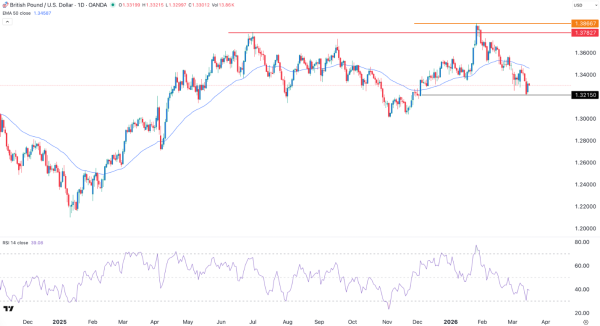
From a technical perspective, the GBP/USD pair is currently in a consolidation phase following a recent rebound from 1.3215. The daily chart reveals the formation of a harami candlestick pattern, a classic reversal signal in Japanese candlestick analysis.
The harami pattern, derived from the Japanese word for “pregnant,” consists of a small bullish candle that follows a large bearish candle, indicating potential trend exhaustion and a possible bullish reversal. This suggests that selling pressure may be weakening in the short term.
However, the broader trend remains bearish to neutral, as the pair continues to trade below the 50-day Exponential Moving Average (EMA) and the Supertrend indicator. These technical indicators are widely used to gauge trend direction and momentum, and their current positioning implies that downside risks persist.
Conclusion: Awaiting Directional Clarity
The GBP/USD exchange rate is currently navigating a complex environment shaped by geopolitical risks, energy market volatility, and monetary policy uncertainty. While short-term price action suggests stability, underlying factors point to potential volatility ahead.
With both the Federal Reserve and the Bank of England expected to hold rates steady, the focus will shift to policy tone, inflation outlook, and future guidance. These elements will be critical in determining whether the pair breaks out of its current range or continues to consolidate.