

The EUR/USD currency pair continues to trade at a critical technical juncture, with recent price action highlighting a shift in short-term momentum. In a previous analysis, the $1.1600 level was identified as a pivotal resistance zone, with a potential downside break opening the door toward $1.1550.
That forecast proved to be highly accurate, as the pair declined sharply, reaching the $1.1550 target by the New York session close, before extending losses further. This move confirmed the validity of bearish momentum and reinforced the importance of key horizontal levels in guiding trading decisions.
However, the current landscape presents a more nuanced picture, as bullish pressure begins to emerge despite a fundamentally supportive backdrop for the US Dollar. The brokers at Taurus Partners offer a detailed breakdown of this topic in this article.
Emergence of Bullish Recovery
Recent price action shows what appears to be a bullish, impulsive rebound, with the pair establishing a higher low at $1.1479. This formation is technically significant, as it suggests the possibility of a short-term trend reversal or at least a corrective upward move within a broader bearish structure.
The formation of a higher low is often interpreted as an early signal of bullish intent, indicating that buyers are stepping in at increasingly higher price levels. In this case, the $1.1479 support level is now acting as a key demand zone, where buy-side liquidity has entered the market.
Despite this, the recovery raises questions due to its disconnect from macroeconomic drivers. Ongoing geopolitical tensions, particularly the war in the Middle East, along with elevated crude oil prices, have generally supported the US Dollar while exerting downward pressure on the Euro. Yet, this relationship appears temporarily absent from current price behavior.
Fundamental Divergence and Market Sentiment
The divergence between price action and fundamental drivers suggests that the current bullish move may be fragile or deceptive. Typically, rising energy prices negatively impact the Eurozone economy due to its reliance on energy imports, while simultaneously strengthening the Dollar through safe-haven demand.
The fact that EUR/USD is rising despite these conditions implies that either the market has already priced in these risks or that short-term technical factors are overriding fundamentals.
This type of divergence often precedes increased volatility, as the market eventually realigns with underlying macroeconomic forces.
Key Resistance at $1.1532
The immediate level to monitor is $1.1532, which represents a nearby resistance zone. This level is likely to act as a decision point for traders evaluating the sustainability of the current bullish move.
If price approaches $1.1532 and forms a clear bearish reversal pattern, such as a pin bar, engulfing candle, or rejection wick, this could provide a high-probability short trade setup. Such a reaction would indicate that selling pressure remains dominant and that the recent rally was merely a corrective bounce.
From a risk-reward perspective, short positions initiated near resistance often offer favorable entry conditions, especially when aligned with the broader trend.
Breakdown Scenario Below $1.1479
An alternative bearish signal would be a decisive breakdown below $1.1479, the newly established support level. A move below this threshold would invalidate the higher low structure, signaling a return to bearish continuation.
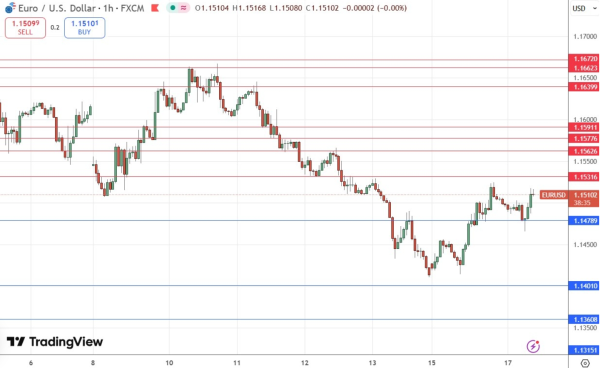
In this scenario, traders could interpret the breakdown as confirmation that the bullish recovery has failed, that sellers have regained control of the market, and that downside momentum is likely to accelerate.
Such a move could open the path toward lower support levels, potentially revisiting or exceeding previous lows.
Bullish Continuation Scenario
If the price manages to break and sustain above $1.1532, the current bearish outlook would need to be reassessed. A confirmed breakout would suggest that bullish momentum is strengthening and that buyers are capable of overcoming immediate resistance.
However, even in this scenario, caution is warranted. There exists a cluster of resistance levels just below $1.1600, which previously acted as a major turning point. This zone is likely to attract significant selling interest, limiting the upside potential.
As a result, any bullish strategy in the current environment may be more suitable for short-term trades or scalping, rather than longer-term positioning.
Conclusion
The EUR/USD pair is currently navigating a complex interplay between technical recovery and bearish fundamentals. While the formation of a higher low at $1.1479 suggests emerging bullish momentum, the broader context still favors downside risks.
The key battleground lies at $1.1532, where the market is likely to reveal its next directional move. Traders should remain flexible, prioritizing price confirmation over bias, and maintaining disciplined risk management.
In the near term, the bullish move may prove to be temporary, especially if macroeconomic pressures reassert themselves. Until a clear breakout occurs, the path of least resistance may still lean bearish, particularly within the $1.1550–$1.1600 resistance cluster.