
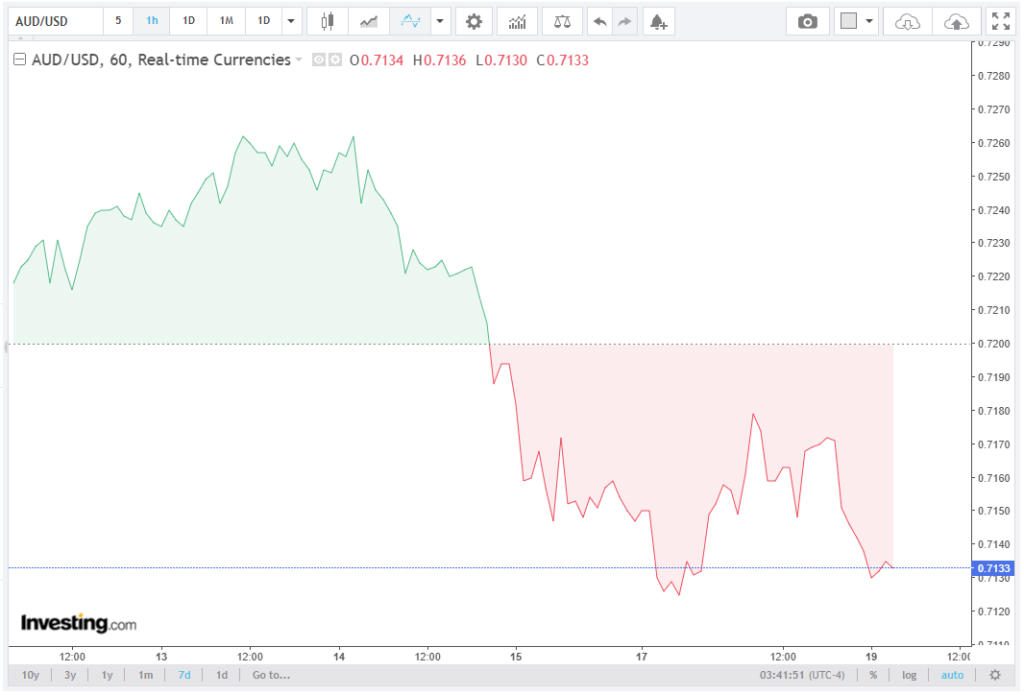
The AUD/USD pair remains under pressure, trading near its monthly low at 0.7125-0.7130 during early European hours on Tuesday. The pair has been weighed down by renewed USD strength, reflecting rising expectations of a 2026 US Federal Reserve rate hike and persistent geopolitical uncertainty.
The technical and fundamental outlook suggests that the path of least resistance is to the downside, with support levels near 0.7100, 0.7056, and 0.7004 potentially in focus. In this piece, the brokers at Taurus Partners break down the topic comprehensively.
USD Strength Weighs on AUD/USD
The pair’s recent weakness is primarily driven by an uptick in USD demand. After pulling back from the highest level since April 7, the USD has regained positive traction. Current futures pricing indicates a roughly 65% probability of a 0.25% Fed rate hike by March 2026, compared to a 50% probability just a week ago.
This renewed pricing pressure reinforces USD strength, exerting downward pressure on AUD/USD, particularly as global markets factor in potential tightening in US monetary policy.
The AUD/USD pair met fresh supply near 0.7140, rejecting bullish advances and signaling that selling interest is present at the upper boundary of the short-term range. The persistence of this supply zone suggests that market participants are favoring USD accumulation over AUD exposure in the near term.
RBA Hawkishness Fails to Support
The Reserve Bank of Australia‘s May policy meeting minutes confirmed that the RBA is likely to raise the cash rate by 25 basis points at the August meeting, projecting the cash rate at 4.35% by year-end. Despite this hawkish stance, the AUD has not responded positively.
Spot AUD/USD remains below the 23.6% Fibonacci retracement level at 0.7173, indicating that domestic rate expectations are insufficient to counter broader USD strength.
This disconnect suggests that domestic monetary policy is currently overshadowed by external factors, including geopolitical tensions and expectations for US rate hikes. The market has priced in further tightening, leaving the AUD vulnerable until more substantial drivers emerge.
Technical Analysis Supports Bearish Bias
Technically, AUD/USD maintains a bearish near-term bias. The pair is trading below the 100-period Exponential Moving Average (EMA) on the 4-hour chart, currently around 0.7187. The 23.6% Fibonacci retracement of the March-May upswing sits at 0.7173, providing immediate resistance.
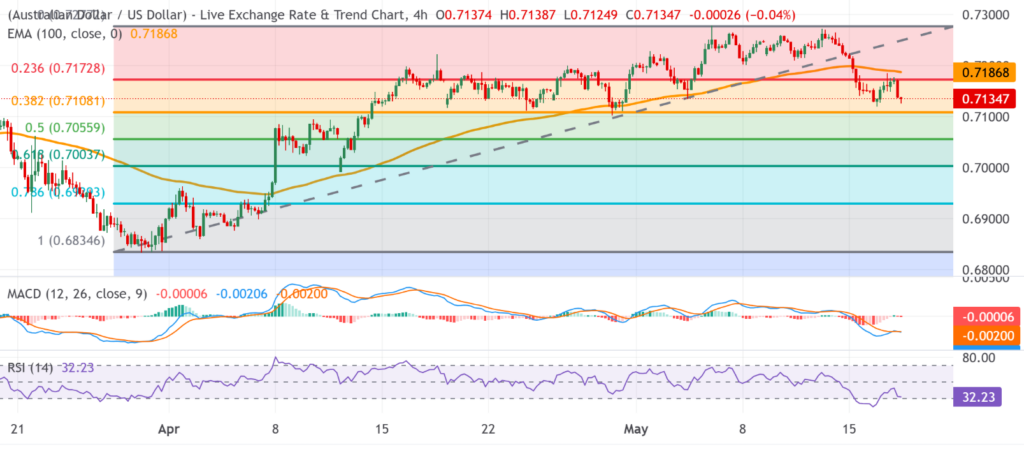
The Relative Strength Index (RSI 14) is currently 32.1, slightly above oversold levels, signaling persistent downside potential. The Moving Average Convergence Divergence (MACD) is -0.0018 with a flat histogram, indicating bearish momentum is present but not accelerating.
Key support levels are 0.7108 (38.2% Fibonacci retracement), 0.7056 (50.0% retracement), and 0.7004 (61.8% retracement). Key resistance levels include 0.7173 (23.6% retracement), 0.7187 (100-period EMA), and the cycle high of 0.7277. A break below 0.7100 would expose 0.7056 and potentially 0.7004, while a sustained move above 0.7187 is required to signal a shift in short-term sentiment.
Medium-Term Technical Considerations
From a medium-term perspective, the AUD/USD pair remains tilted toward further downside. The 100-period EMA at 0.7187 is a critical pivot; sustained trading below this level reinforces the bearish trend. The 23.6% Fibonacci retracement at 0.7173 has acted as resistance in recent sessions, and additional attempts to breach it have been rejected.
The 38.2% retracement at 0.7108 is the first key support; a break below this could test the 50.0% retracement at 0.7056 and 61.8% retracement at 0.7004. These levels align closely with historical swing lows, making them areas where price reaction is likely.
Upside resistance remains limited. Any recovery must first clear 0.7173 and 0.7187 to challenge 0.7220-0.7230, with a more decisive trend reversal only occurring above the cycle high at 0.7277.
Conclusion
The AUD/USD pair is trading near monthly lows, pressured by USD strength, geopolitical uncertainty, and Fed rate hike expectations. Hawkish RBA minutes have failed to provide significant support, leaving the pair with a bearish near-term bias.
Technical analysis highlights key support levels at 0.7108, 0.7056, and 0.7004, while resistance levels are at 0.7173, 0.7187, and 0.7277. Intraday momentum remains negative, with the RSI at 32 and MACD slightly below zero, indicating that further downside is likely unless a major catalyst reverses market sentiment.
Traders should monitor the 0.7100 handle as a key inflection point. A break below could accelerate losses, whereas a sustained recovery above 0.7187 would be required to signal a potential trend reversal. The medium-term outlook remains tilted toward the downside, with the path of least resistance pointing lower in the absence of significant positive developments.