
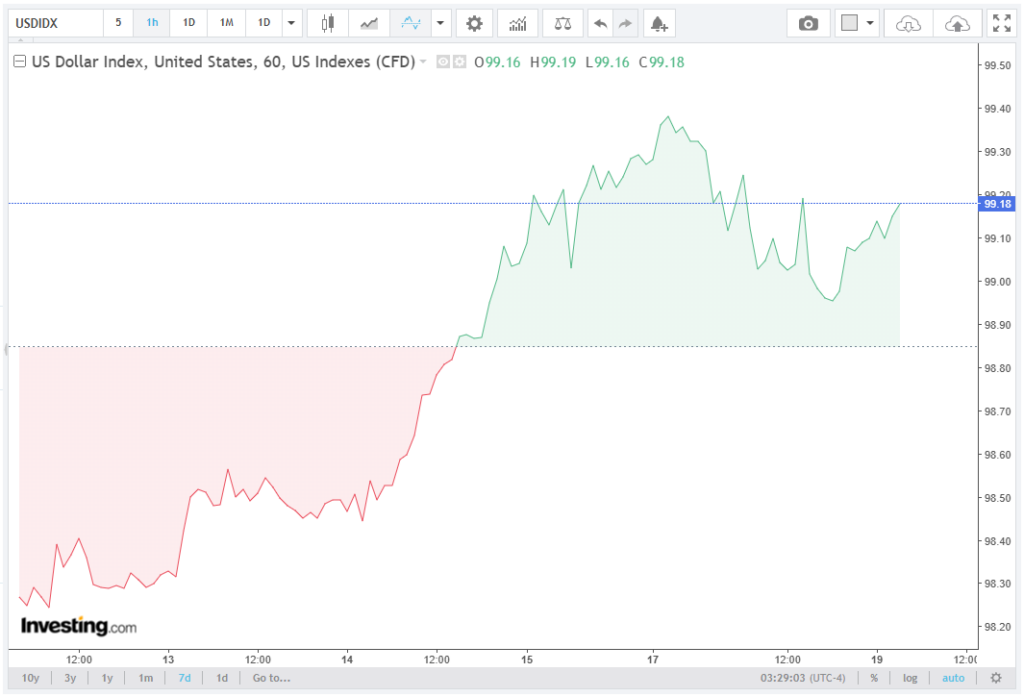
The US Dollar Index (DXY), which tracks the US Dollar (USD) against a basket of six major currencies, maintained gains above the 99.00 level on Tuesday. After posting modest declines in the prior session, the DXY traded around 99.10 during Asian hours, reflecting renewed market expectations of a more hawkish Federal Reserve (Fed) stance.
The combination of rising Treasury yields, persistent inflation pressures, and geopolitical developments continues to drive USD strength across global markets. The article from Taurus Partners provides a thorough look at this subject, courtesy of their brokers.
Hawkish Fed Outlook Supports USD
Market participants are increasingly pricing in a tighter monetary policy trajectory by the Federal Reserve. The benchmark 10-year US Treasury yield spiked to 4.659%, the highest since February 2025, before retracing slightly to 4.591%, remaining near multi-month highs. The 2-year Treasury yield also climbed to 5.12%, reinforcing expectations of short-term interest rate increases.
The sharp rise in yields highlights concerns that energy price pressures, with WTI crude oil trading near $95 per barrel, could feed into headline consumer inflation, potentially prompting further rate hikes. Futures markets are currently pricing in a 70% probability of a 25 basis-point rate increase at the next FOMC meeting, with implied terminal rates approaching 5.50% by Q4 2026.
Elevated yields provide support for the USD, as higher returns on US-denominated assets attract foreign capital inflows, particularly in the fixed-income market. The correlation between the DXY and 10-year Treasury yields remains strong, with a 0.82 correlation coefficient over the past 30 trading days, suggesting that sustained yield increases are likely to reinforce USD strength.
Technical Dynamics of the US Dollar Index
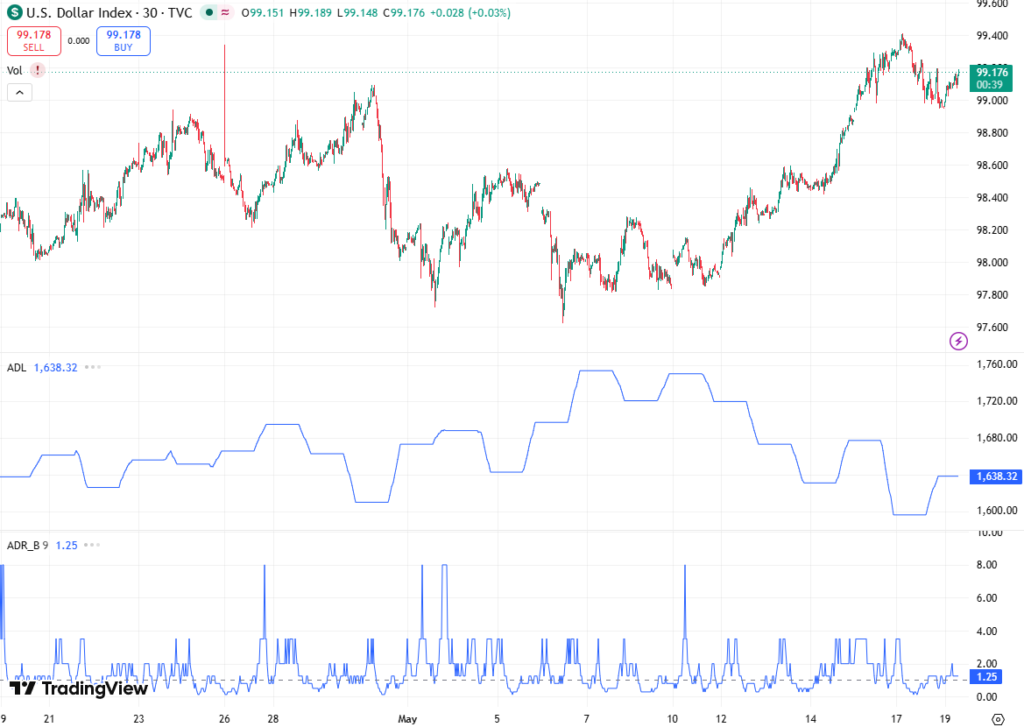
From a technical perspective, the DXY remains in a bullish consolidation phase above the 99.00 support level. Intraday trading has shown key support at 98.80, with resistance levels observed at 99.30 and 99.50. The 14-day Relative Strength Index (RSI) sits at 62, indicating moderate upside momentum, while the 50-day moving average near 98.60 provides additional support in the event of a retracement.
Recent price action shows that the DXY has rebounded after testing the 98.90 level, with intraday highs reaching 99.12 before consolidating. Volume-weighted average price (VWAP) levels suggest that current trading activity favors continued USD strength, particularly if 10-year yields maintain levels above 4.55%.
Treasury Yields and Inflation Expectations
The surge in Treasury yields underscores market sensitivity to inflation and monetary policy signals. 10-year yields climbed roughly 28 basis points intraday, while 2-year yields advanced 18 basis points, reflecting an ongoing steepening of the yield curve at the short end.
Market-derived inflation expectations, as measured by the 5-year breakeven rate, remain at 2.9%, slightly above the Fed’s target range, reinforcing the case for a hawkish policy bias. The 5-year, 5-year forward inflation swap is at 2.85%, signaling that markets expect moderate but persistent inflationary pressures over the medium term.
Geopolitical Developments and Market Risk Sentiment
Although expectations of a hawkish Fed drive USD support, risk sentiment improved temporarily after a planned military strike in the Middle East was delayed, following requests from regional allies for more time to negotiate diplomatic resolutions.
This development reduced immediate safe-haven demand, causing minor retracement in the USD and Treasury yields, but did not materially weaken the Greenback’s upward trend.
Short-term volatility indices, such as the CBOE Volatility Index (VIX), declined to 16.8, down from 18.3 in the previous session, signaling a mild easing in risk aversion. FX implied volatility for the EUR/USD 1-month has also eased to 6.5%, indicating that while geopolitical risk has temporarily subsided, investors remain cautious.
Market Implications and Outlook
The USD’s resilience above 99.00 has implications across global markets. Emerging market currencies, particularly USD-denominated debt issuers, face increased repayment pressures as borrowing costs rise. Conversely, US exporters may experience reduced competitiveness, as a stronger USD makes exports more expensive in foreign markets.
Fixed-income portfolios are adjusting to higher yields, with duration-sensitive instruments under pressure. In equity markets, sectors such as technology and utilities, which are sensitive to interest rate movements, may experience elevated volatility, while energy and commodity sectors could benefit from the stronger dollar offset by rising crude prices.
Conclusion
The US Dollar Index remains supported above 99.00, driven by expectations of a hawkish Federal Reserve, elevated Treasury yields, and persistent inflation pressures. Temporary easing of geopolitical tensions has provided modest safe-haven headwinds, but the broader macroeconomic backdrop favors USD strength.
Investors should monitor Treasury yields, inflation expectations, and risk sentiment indicators, as these will continue to shape USD performance. A sustained uptrend in yields and continued hawkish Fed positioning could reinforce the DXY’s bullish momentum, keeping the Greenback elevated in the near term.