

The USD/JPY currency pair is currently positioned at a critical inflection point, as price action continues to test a historically significant resistance zone that has remained intact since 1990. This long-term ceiling represents more than just a technical barrier; it is a multi-decade structural level that could redefine the broader trajectory of the pair if decisively broken. This article features a comprehensive breakdown of the topic, prepared by the brokers at Taurus Partners.
During Friday’s trading session, the US dollar initially pulled back modestly, only to recover and exhibit renewed bullish momentum. This type of price behavior signals underlying strength, with buyers continuing to step in on dips, reinforcing the notion of a sustained uptrend.
The market is now in the midst of an attempted breakout, and the implications of a successful move higher could be profound, especially from a long-term technical perspective.
Interest Rate Divergence Driving Momentum
One of the most important drivers behind the USD/JPY rally is the interest rate differential between the United States and Japan. The Federal Reserve continues to maintain a relatively hawkish stance, supported by resilient economic data, while the Bank of Japan (BoJ) remains firmly committed to an ultra-loose monetary policy.
This divergence creates a powerful carry trade dynamic, where investors borrow in low-yielding yen and invest in higher-yielding US dollar assets. As a result, capital flows continue to favor the dollar, applying persistent downward pressure on the yen.
Recent US labor market data, particularly the surge in unfilled job openings, underscores the strength of the American economy. With job vacancies reaching levels not seen in over 2.5 years, the data suggests that inflationary pressures remain sticky, reducing the likelihood of aggressive rate cuts in the near term.
This reinforces expectations that US interest rates will remain elevated, further widening the yield gap and supporting USD/JPY upside potential.
Inflation and Geopolitical Risk Factors
Beyond monetary policy, macro-level forces are also contributing to the bullish outlook for the US dollar. Ongoing geopolitical tensions, particularly in the form of global conflict, are expected to sustain inflationary pressures through disruptions in energy markets, supply chains, and commodity pricing.
In such an environment, the US dollar increasingly functions as a global safe-haven currency, especially when combined with its yield advantage. While the Japanese yen has traditionally held safe-haven status, its appeal is currently undermined by the Bank of Japan’s inability to normalize policy.
This creates a unique scenario where risk-off sentiment may paradoxically benefit USD/JPY to the upside, rather than triggering yen strength.
Technical Formation: Breakout from a Long-Term Pattern
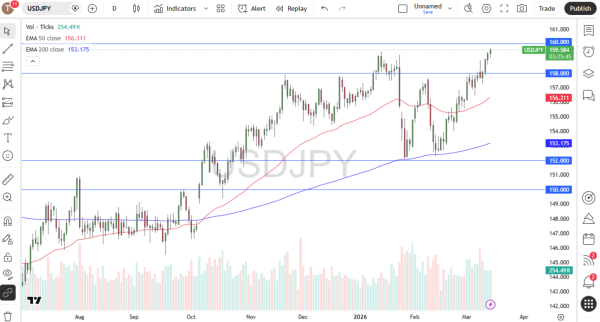
From a technical analysis standpoint, the USD/JPY pair appears to be breaking out of a major “W” pattern, also known as a double-bottom formation. This pattern is typically associated with long-term trend reversals and signals the potential for a significant upward move once resistance is cleared.
In addition, the broader chart structure resembles a rounding bottom, which is a gradual accumulation pattern that often precedes explosive bullish expansions. The measured move projection derived from this formation suggests a potential long-term target near the 250 yen level, a dramatic but technically plausible scenario given the scale of the pattern.
Such a move would represent a generational shift in currency valuation, echoing the massive trends initiated during the early 1990s.
The 160 Yen Level and Central Bank Intervention Risk
A key level to watch in the near term is the 160 yen threshold, which previously triggered verbal intervention from the Bank of Japan. This level carries significant psychological and policy importance, as Japanese authorities have historically acted to stabilize excessive currency weakness.
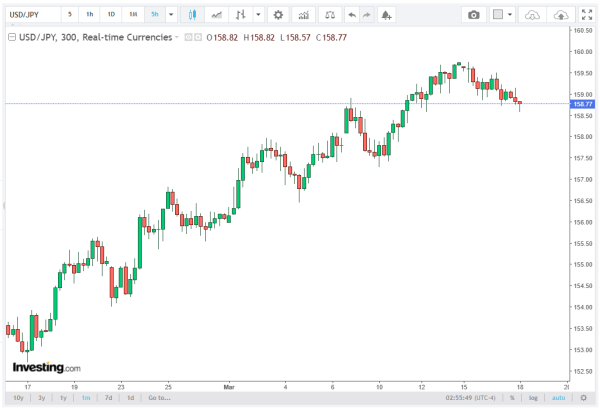
However, the effectiveness of such intervention remains questionable unless supported by actual policy tightening, which currently appears unlikely. The BoJ’s structural constraints, including low domestic inflation and economic fragility, limit its ability to raise interest rates meaningfully.
If USD/JPY manages to break and sustain levels above 160, it could trigger accelerated yen depreciation, potentially leading to a sharp continuation of the uptrend. Traders should remain aware of the possibility of short-term volatility spikes driven by official comments or direct intervention, but the underlying trend bias remains bullish.
Conclusion
The USD/JPY pair is approaching a historically significant breakout zone, with the potential to reshape long-term currency dynamics. The convergence of macroeconomic strength, interest rate divergence, and technical breakout patterns suggests that the market may be entering a new bullish phase.
While risks related to central bank intervention and market volatility remain, the broader outlook favors continued upside, particularly if the 160 yen barrier is decisively breached.
In this environment, traders and investors alike should closely monitor price action around key resistance levels, as a confirmed breakout could mark the beginning of a multi-year bullish expansion in USD/JPY.