
The NZD/USD pair opened the session near 0.5880 on Tuesday, benefiting from a weaker US Dollar (USD) amid Federal Reserve (Fed) transition uncertainty and mixed developments in US-Iran negotiations. This article by Taurus Partners presents a complete and insightful analysis of the topic.
Traders remain focused on shifts in monetary policy expectations and geopolitical developments, which continue to influence risk sentiment and the performance of risk-sensitive currencies like the New Zealand Dollar (NZD).
US Dollar Faces Pressure Amid Fed Leadership Transition
The US Dollar remains under pressure as markets evaluate the implications of an upcoming Federal Reserve leadership change. The Senate approved the nomination of Kevin Warsh as the next Fed Chairman, with the swearing-in scheduled for Friday, May 22, replacing the current temporary Fed Chair.
The potential for a shift in policy bias, whether toward tightening, neutral, or accommodative stances, has resulted in short-term USD weakness, contributing to strength in NZD/USD. This dynamic reflects broader market concerns over interest rate differentials, liquidity flows, and the impact of monetary policy signaling on risk-sensitive currencies.
Market pricing in Fed rate expectations shows a slight adjustment following the leadership news, with the futures market now assigning a 45% probability of a 25 basis point rate hike by the next FOMC meeting, down from 60% last week. This repricing has weighed on the US Dollar Index (DXY), which currently trades near 101.7, down from recent highs above 102.3.
Geopolitical Developments Support Risk Currencies
Mixed developments in US-Iran negotiations have reinforced cautious risk sentiment. Reports indicate that the latest proposals from both sides remain inconclusive, with partial concessions and ongoing disagreements on oil sanctions. Market participants have responded with moderate risk-on flows, supporting the NZD as a high-beta currency.
The uncertainty has maintained a bid for risk-sensitive assets, while safe-haven demand for the USD remains limited. As a result, NZD/USD has benefitted from both dollar weakness and renewed appetite for carry trades, particularly in light of New Zealand’s overnight cash rate of 5.25%, compared with the implied US federal funds target range of 5.00–5.25%.
Technical Analysis of NZD/USD
From a short-term technical perspective, NZD/USD trades at 0.5876 on the four-hour chart. The pair remains under pressure below both the 20-period Simple Moving Average (SMA) at 0.5881 and the 100-period SMA at 0.5908, reflecting a slightly bearish near-term bias despite an intraday bounce.
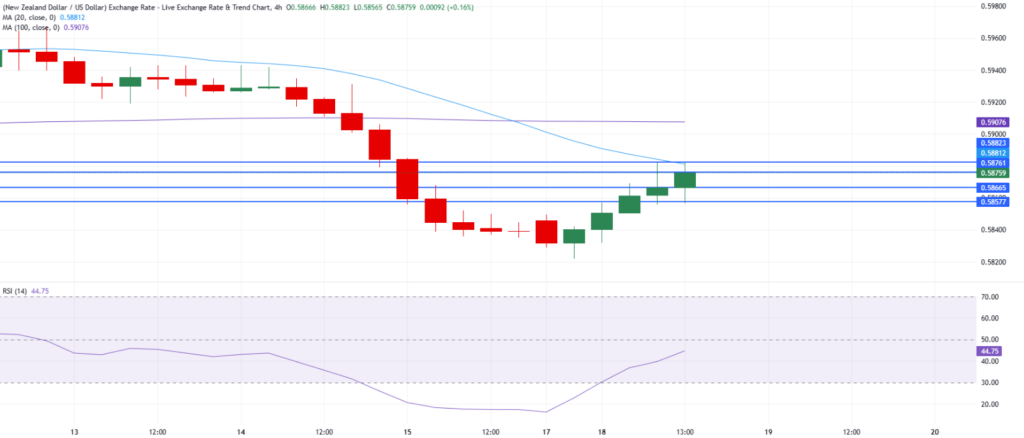
The Relative Strength Index (RSI) stands at 45, suggesting that bearish momentum is fading, but the pair has not yet gained sufficient bullish momentum to break key resistance levels.
The MACD on the four-hour chart shows a narrowing negative histogram, indicating potential stabilization in the short term, while stochastic oscillators approach oversold conditions near 22, hinting at a possible short-term technical rebound.
Immediate resistance is located at the 0.5876 pivot, followed by the 20-period SMA at 0.5881, and a horizontal barrier at 0.5882. A more significant ceiling exists at the 100-period SMA at 0.5908, which coincides with the 50% retracement level of the recent 0.5850–0.5920 intraday range.
On the downside, initial support is found at 0.5867, with a secondary floor at 0.5858, corresponding to the recent swing low. A decisive break below 0.5858 could signal a continuation of the bearish short-term trend, potentially targeting 0.5845 and the 200-period SMA at 0.5838.
Short-term intraday volatility is expected to remain elevated, with the average true range (ATR) on the four-hour chart at 0.0042, indicating potential intraday swings of around 40 pips. This suggests that traders should monitor key levels closely for breakout or rejection patterns.
Market Implications
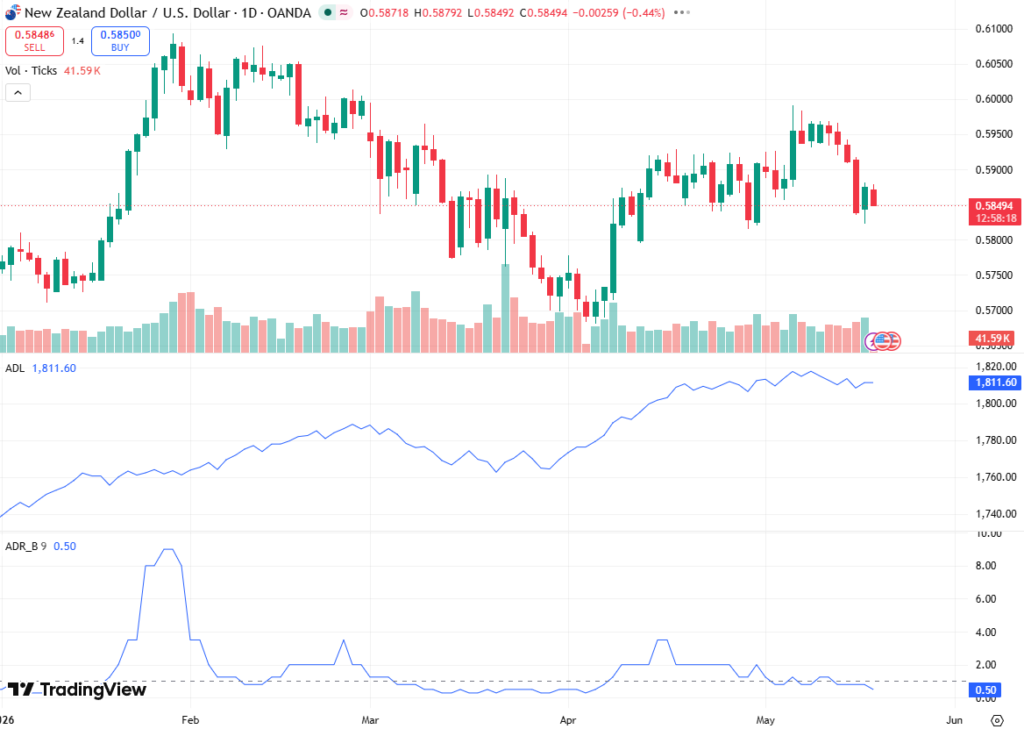
The current environment favors NZD strength amid USD softness, though several risk factors remain. Fed policy uncertainty is key, as any indication of a more hawkish tilt by the new Fed Chair could strengthen the USD and cap NZD/USD upside. Geopolitical risk, particularly ongoing US-Iran negotiations, may influence risk sentiment, driving safe-haven flows back into the USD.
Additionally, technical resistance at the 20- and 100-period SMAs (0.5881 and 0.5908) provides notable ceilings, limiting short-term bullish moves.
The combination of monetary policy uncertainty and geopolitical caution has created a mixed technical environment, where short-term support at 0.5867–0.5858 remains crucial. Traders can look for potential intraday reversals or trend continuations based on breaks of these technical thresholds.
Conclusion
NZD/USD gains reflect a weaker US Dollar amid Fed transition uncertainty and cautious geopolitical sentiment. While technical indicators show fading bearish momentum, the pair remains below critical moving averages, suggesting limited upside without additional fundamental support.
The trajectory of NZD/USD will continue to depend on interest rate differentials, Fed policy signals, and geopolitical developments, underscoring the need for disciplined risk management in this environment.