
The GBP/JPY currency pair has softened to around 213.15 in the early Tuesday European session trading, reflecting a cautious market mood ahead of key UK labor market data. Despite the recent pullback, the positive outlook for the cross remains intact, though further consolidation in the near term cannot be ruled out. The team at Taurus Partners provides a thorough breakdown of this issue in their article.
Traders are closely monitoring the pair as the Japanese Yen (JPY) gains support from a stronger-than-expected Japan GDP report for the first quarter (Q1). Meanwhile, the market eagerly awaits the UK employment data, which could significantly influence the British Pound (GBP) in the coming sessions.
GBP/JPY Performance Overview
During the early European session on Tuesday, the GBP/JPY cross traded in negative territory, hovering near 213.15. The JPY strength following the better-than-expected Japan GDP reading acted as a headwind for the pair, partially offsetting the broader bullish momentum observed in recent weeks.
The GBP remains under pressure as traders position themselves ahead of the UK labor report, with market participants particularly focused on the Unemployment Rate and the Claimant Count Change.
Analysts forecast the Unemployment Rate to remain steady at 4.9% in March, while the Claimant Count Change is expected to rise by 27.3 thousand in April. Positive surprises in these indicators could lift the GBP and push the cross back toward key resistance levels, while disappointing figures may extend the near-term pullback.
Technical Analysis
From a technical perspective, the daily chart shows GBP/JPY maintaining support above the 100-day Exponential Moving Average (EMA) and the lower Bollinger Band, which helps underpin the broader uptrend despite recent losses.
Currently, the price sits just below the Bollinger mid-line, while the Relative Strength Index (RSI) hovers around 48, indicating neutral momentum after previous overbought conditions cooled. This suggests the pair may continue to consolidate before any decisive move.
Resistance Levels
On the topside, traders are eyeing initial resistance at the Bollinger middle band near 213.85. A break above this level could signal a resumption of the bullish trend, with the upper Bollinger Band at 216.45 representing the next key upside target.

Monitoring these levels is critical, as a sustained rally above 213.85 would indicate that the GBP is regaining strength against the JPY, potentially fueled by favorable UK employment data. Technical traders may look for confirmation from the RSI, which would need to climb back toward the overbought zone to validate stronger upside momentum.
Support Levels
On the downside, immediate support resides at the 100-day EMA, approximately at 211.55, with the lower Bollinger Band at 211.22 providing a secondary cushion. A break below this cluster would likely signal a weakening of the bullish bias, potentially triggering a deeper correction toward 210.00 or lower.
The presence of these technical support zones highlights the importance of careful risk management for traders, as stop-loss placement below the EMA or the lower Bollinger Band could help mitigate losses in the event of a sharp downward move.
Market Outlook
The GBP/JPY cross remains in a positive long-term trend, supported by broader GBP strength amid expectations of economic recovery in the UK. However, the near-term price action is likely to remain choppy, as market participants digest the Japanese GDP report and await the UK labor statistics.
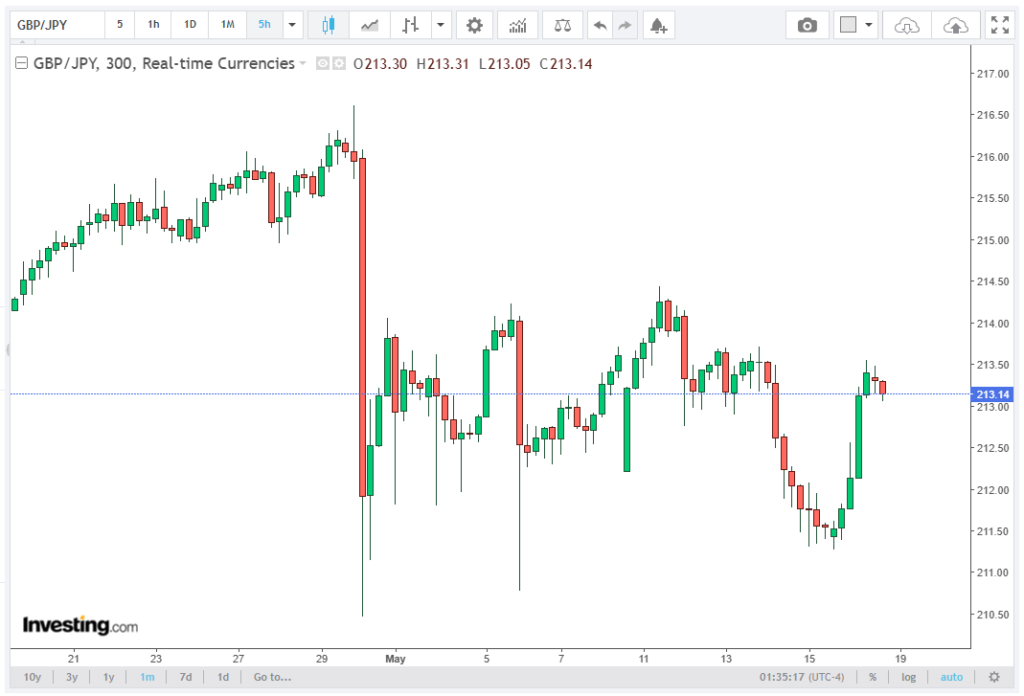
If the UK Unemployment Rate remains steady at 4.9% and the Claimant Count Change rises modestly, the GBP could regain momentum, pushing the cross toward 213.85 and potentially challenging the upper Bollinger Band at 216.45. Conversely, a weaker-than-expected UK jobs report may strengthen the JPY, leading to a test of support levels near 211.55 and 211.22.
Key Trading Considerations
For traders, several key factors are essential to monitor. Economic data, such as UK employment figures, including the Unemployment Rate and Claimant Count Change, are likely to dictate short-term GBP movements. Technical levels also play a critical role, with resistance at 213.85 and support at 211.55 being crucial for risk management.
Momentum indicators, like RSI readings near 48, suggest a neutral bias, indicating potential for either upside continuation or downside correction. Finally, market sentiment, including broader risk appetite and safe-haven flows into the JPY, could significantly influence intraday swings.
Overall, the GBP/JPY price forecast indicates a softening trend near 213.00, with traders closely awaiting UK jobs data to guide the next directional move.
Conclusion
The GBP/JPY cross trades near 213.15 as markets digest strong Japan GDP data and anticipate UK labor market figures. Resistance at 213.85 and support at 211.55 define the key technical range, while RSI and Bollinger Bands provide additional guidance.
Traders should remain alert to data surprises, as they could trigger significant short-term volatility without altering the longer-term bullish trend.